
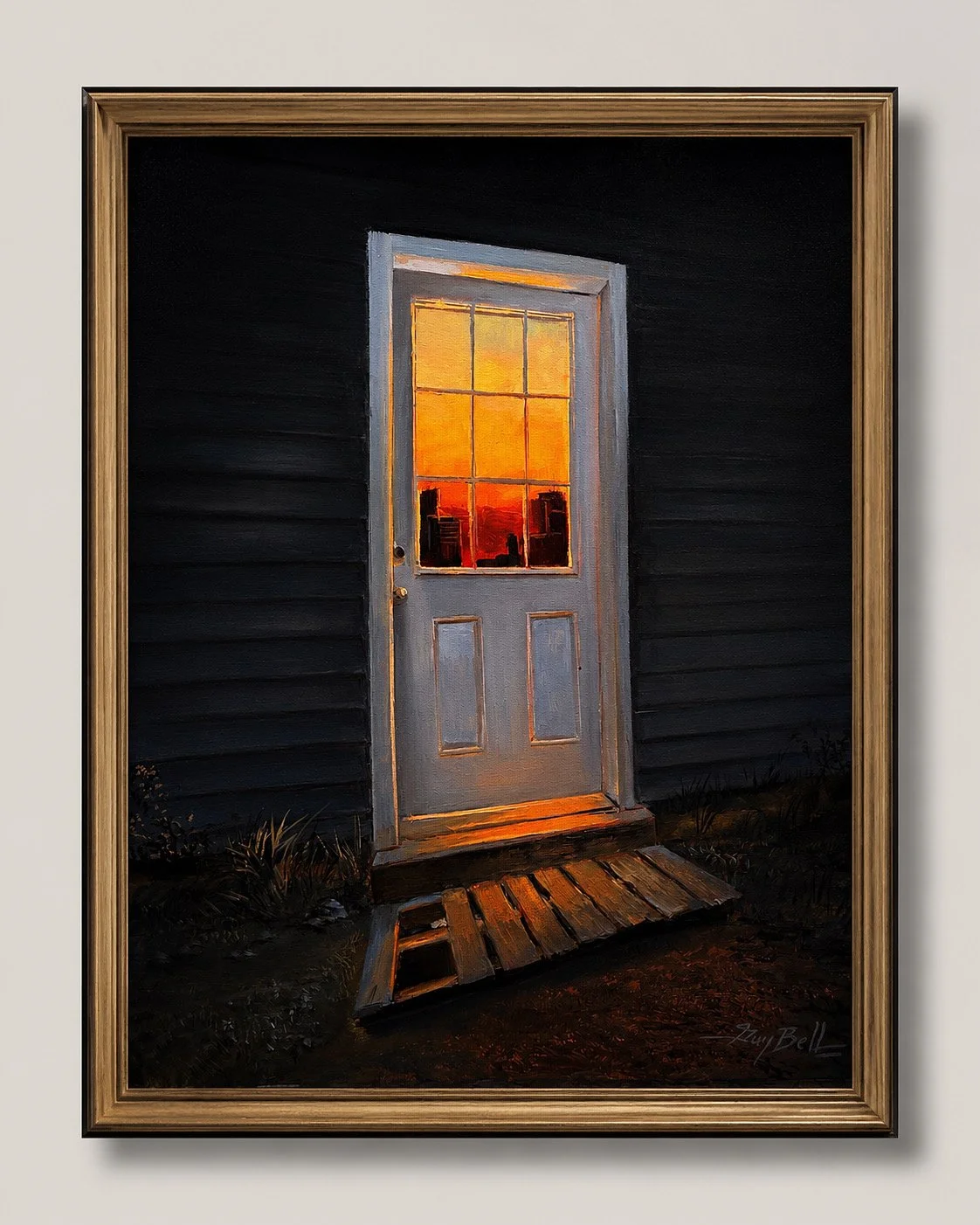
Threshold Realism
Threshold Realism is a contemporary painting style concerned with significance: the experience of meaning before meaning becomes fully understood.
Through landscapes, interiors, reflections, shadows, and traces of human presence, the work investigates the relationship between memory, atmosphere, perception, and meaning. Rather than presenting answers, these paintings create conditions in which viewers participate in the emergence of significance.
Foundations
What is THRESHOLD REALISM? Every generation inherits a way of seeing. Not merely a style of painting or a collection of visual preferences, but a deeper assumption regarding the relationship between perception and reality itself. For centuries, artists sought to depict the world as faithfully as possible. Technical mastery functioned as a means of reducing uncertainty. The better an image mirrored reality, the closer it was believed to approach truth. The twentieth century challenged this assumption repeatedly. Modernism questioned representation. Abstraction questioned subject matter. Conceptualism questioned the necessity of the object itself. Digital technologies transformed images into infinitely reproducible information. Social media accelerated visual consumption until images increasingly existed not as experiences but as signals. Throughout these developments, one question remained largely unresolved: What is the relationship between perception and significance? Threshold Realism emerges from that question. It is not an attempt to revive realism. Nor is it a rejection of contemporary art. It seeks to exists beside both. Threshold Realism begins with the observation that human beings often experience significance before they understand it. A place may feel important before we know why. A memory may possess emotional certainty despite factual incompleteness. A landscape may communicate something meaningful while resisting explanation. A room may feel inhabited despite standing empty. A shadow may contain more narrative than the figure that cast it. These experiences are common, yet difficult to articulate.Language often arrives after perception. Explanation follows feeling and meaning precedes understanding at a fundamental experiential level. We evolved to react to stimuli before we became aware of the language we use to describe it. This condition forms the foundation of Threshold Realism. The movement proposes that painting is uniquely suited to explore these experiences because painting itself occupies a threshold. A painting is simultaneously image and object. n It is illusion and material. The viewer encounters both realities at once. From a distance, a painting appears coherent. Light organizes itself. Atmosphere emerges. Relationships become visible and coherent. The image holds together. As the viewer approaches, certainty begins to dissolve. Brushstrokes emerge and edges fragment. Paint reveals itself as paint. Tiny imperfections are everywhere. The surface falls apart. Threshold Realism embraces this paradox. The dissolution of certainty is not a failure of representation. It is one of the movement's central subjects. The closer we investigate memory, perception, consciousness, anticipation, beauty, and meaning, the more complex they become.The paintings therefore function as physical analogues for perception itself. They seek neither certainty nor confusion.Instead they occupy the space between. A threshold. Throughout the movement, recurring subjects appear. Roads marked by passage. Gardens shaped by care. Water disturbed by unseen forces. Fog obscuring distance. Reflections that simultaneously reveal and conceal. Doors standing partially open. Traces of interaction without explicit explanation. These forms are not symbols.They are conditions.They exist because they preserve mystery. Threshold Realism is less interested in events than in the evidence surrounding them. The moment before. The moment after. The residue of experience. The anticipation of action. The aftermath of presence. A rutted road may contain greater narrative impact than a depicted traveler. An indented cushion may reveal more than a portrait. An open door may communicate more than a figure crossing through it. The movement therefore privileges implication over declaration. Action begs for attention. Wonder demands it.
*Exerpt from “Fractured Memory: The Case for Threshold Realism” by Guy W. Bell
Principles
-
The emotional experience of an image often arrives before its intellectual interpretation. Threshold Realism begins at this point. Meaning frequently emerges from emotion rather than the reverse.
-
Beauty attracts attention. Meaning sustains it. A successful painting creates conditions in which both become possible.
-
Meaning does not exist entirely within the artwork. It exists as an experience shared between the viewer and the object’s creator
-
The Image Holds Together. The Surface Falls Apart.
At a distance, the image should function as a unified experience. At close range, paint should reveal itself as paint. Both conditions are necessary and each are equally true.
-
The mind experiences before it understands